
Rabbel
Rabbel is a daily Swedish word game for those who like to see patterns, test words and get the brain working in short but intense rounds. Instead of guessing a single hidden word, you get a board of letters and the task of finding as many real Swedish words as possible. You drag between adjacent letters in the order that forms a word, and every word found brings you closer to the day's goal. This makes Rabbel a game that is easy to open for a few minutes but hard to put down when you see that there are still words left on the board. The combination of word hunt, scoring and daily challenges suits both seasoned word game lovers and players who just want a quick break with something tricky.
What sets Rabbel apart from many other word games is that the focus is on the breadth of your vocabulary. You don't solely need to find the longest or most unusual word. Instead, it is about reading the letter board, seeing which paths are possible and discovering words of several different lengths. At least three adjacent letters are required for a valid word, which means every move needs to be planned. A short path can lead to a simple three-syllable word, while a longer path can open up more points and a bigger step forward in today's puzzle. It is precisely the interplay between overview and attention to detail that makes the same type of board feel new every day.
Rabbel clearly shows how many words remain, sorted by word length. It gives the player a concrete picture of the task without giving away the answers. If you have found several short words, you can see, for example, that longer words are still missing and start looking for new combinations. The game also features levels, points and rewards that make progress feel clear during today's round. When you need help, clues can show the direction without removing the challenge itself. The words can also be looked up in SAOL, making the game interesting even for those who want to discover new Swedish words and understand why a certain combination works.
For many, the daily rhythm is an important part of the experience. Rabbel is not just a word game that you play once and forget. Every new puzzle becomes a small recurring challenge that can be shared with others afterwards. You can compare results, try to improve your own accuracy and see how far you get before you choose to skip or use a clue. That makes Rabbel a great example of why daily word games have become so popular: they require no long runway, but they reward curiosity, perseverance and an active interest in language.
In this guide, we go through the rules of Rabbel step by step. You will learn how the letter board works, what counts as a valid word, how points and clues are used, and how you can get more out of today's puzzle without spoiling the joy of finding the words yourself. We also briefly compare Rabbel with the Danish word game Splejser, which is based on a different but related idea of creating words from given parts. The goal is to give you a clear, fact-based and easy-to-use walkthrough of Rabbel, whether you are playing for the first time or want to get better at finding the words that others miss.

Jabber rules – how to play
Rabbel is a Swedish daily word game where you look for words in a letter grid. Instead of typing a guess on a keyboard, you drag across letters that are adjacent to each other. When the letters form a valid Swedish word, it counts as one of the day's found words. The objective is to discover as many words as possible while seeing how far you can get in today's puzzle. The game combines word knowledge with a simple visual layout, making it work just as well as a quick morning challenge as a longer period of concentrated word hunting.
The most important thing to understand is that Rabbel is not about randomly trying letter combinations. You need to read the board, find paths between the letters and think about which Swedish words can actually be built. The more words you find, the clearer it also becomes which gaps still remain. For those who like games where you can both track progress and improve your vocabulary, Rabbel offers a clear, recurring challenge. You can play today's puzzle, share the result and come back when a new board is available.
Facts about Scribble
| The facts | How it works |
|---|---|
| Type of game | Daily Swedish word game |
| Task | Find Swedish words in a letter board |
| Minimum requirement | A word needs at least three contiguous letters |
| Game mode | Trace over the letters in the order that builds the word |
| Progress | Points, steps and rewards are shown below today's puzzle |
| Glossary | Found words can be looked up in SAOL |
| Sharing | Today's results can be shared after the round of matches |
How the letter board works in Rabbel
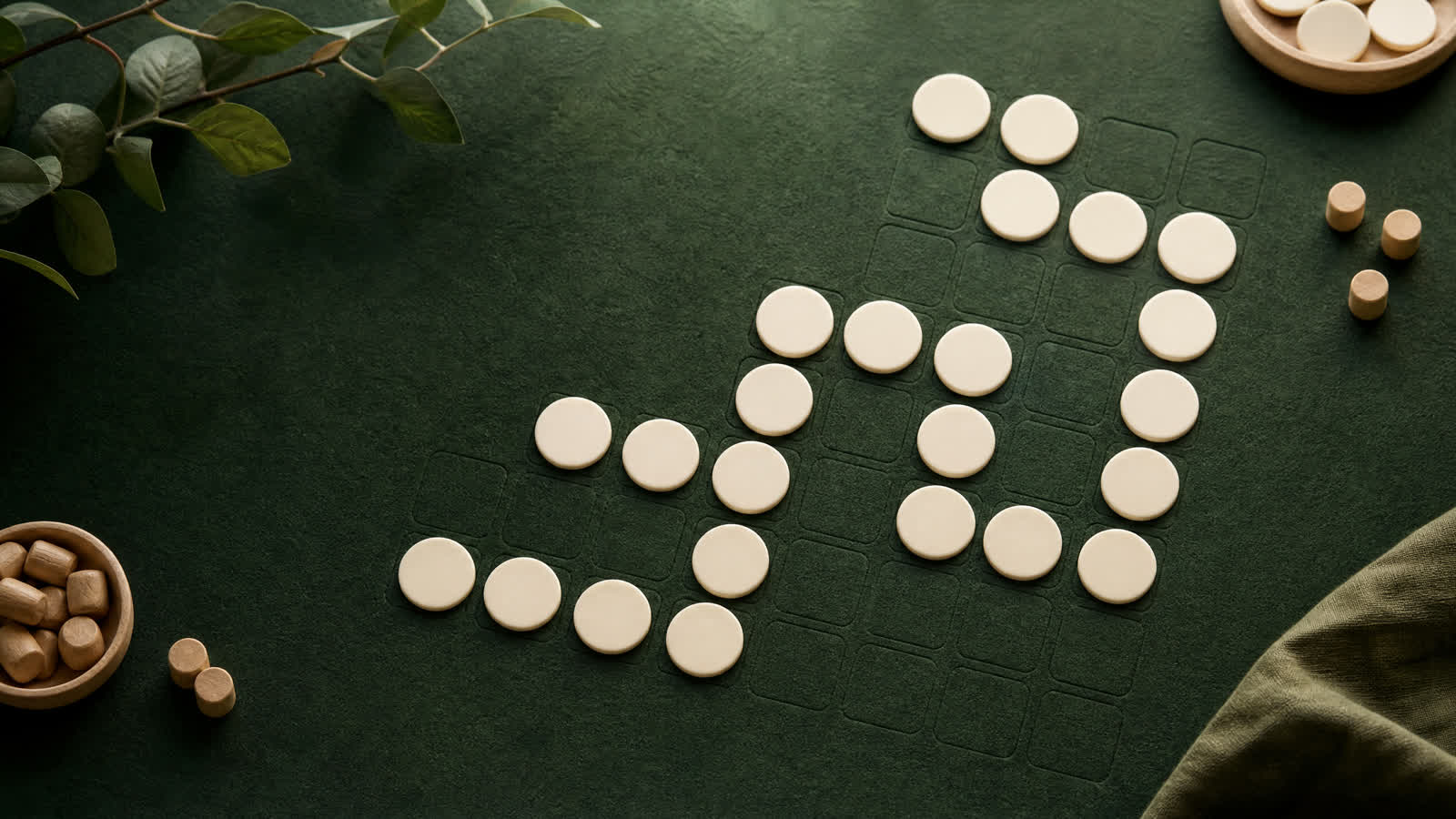
When you open Rabbel, you are met with today's letter board. The letters are in a fixed shape, and each word is created by dragging from one letter to the next. The letters must be adjacent, which means that the path through the board is part of the challenge itself. You therefore cannot simply choose letters from anywhere on the screen. Instead, you need to see which letters are next to each other and whether they can be combined into a real Swedish word.
This mechanic means that Rabbel rewards both a feel for language and spatial awareness. A word that feels obvious in your head might not be possible to create from today's specific board, whereas an unusual letter path can reveal a word you didn't think of at first. Therefore, it is often wise to start with short, familiar words and then use them to figure out which parts of the board are most useful. Once you have got into the rhythm, it becomes easier to spot suffixes, inflections and longer combinations.
Rabbel also shows words by length. This means you can see if today's puzzle still contains, for example, three-, four-, five-letter or longer words. That information does not reveal the answers, but it gives a clear direction. If you have already found many short words, you can shift your focus to longer moves. If few short words have been found, it may instead be worth checking common short words and inflectional forms. In this way, the board becomes a problem-solving task rather than a pure guessing game.
Rabble's basic rules
For a word to count in Rabbel, it must consist of at least three adjacent letters. That is the fundamental rule that determines how you build words. You choose the first letter, continue to an adjacent letter and drag onwards until the whole word is highlighted. The order in which you drag is important, as it must correspond to the spelling of the word. A good way to avoid mistakes is to read the word quietly to yourself while following the path across the board.
Not all possible combinations naturally become words. Rabbel is based on Swedish words, and when a word has been accepted it can also be looked up in SAOL. This means the game can be used both as entertainment and as a way to discover words you do not use every day. If you are unsure about a found word, the lookup function can provide more context. For readers who want to understand the linguistic basis, there is Swedish Academy glossaries as a relevant external resource.
There is no need to rush solutions. Rabbel practically rewards a methodical play style. Look at the beginning and end of possible words, look for common Swedish endings and try starting from the vowels. A letter that seems difficult can often become useful when put together with the right neighbour. When you get stuck, it is better to change part of the board than to repeat the same attempt. Then you will often see new patterns that were previously hidden by the words you already had in your head.
Scores, steps and clues in Rabbel
Rabbel shows your score and steps during the course of the game. Today's game view also shows how many of the day's words have been found and how many remain. This creates a clear sense of progression without you needing to know all the solutions from the start. When you reach new sub-goals you can receive rewards, and the interface shows, among other things, when clue numbers become the next reward. The idea is that the player should be able to work further towards a concrete goal instead of just quitting when the first easy words have been found.
Clues are most useful when you have made some progress but cannot see how to proceed. Use them as support to choose your next strategy, not as a replacement for the word hunt itself. If you receive information suggesting that more words remain of a certain length, you can search for new paths that yield precisely that type of word. That way, you preserve the fun part of the game: the moment when a new chain of letters suddenly becomes a word.
A good rule of thumb is to first try to find your own solutions and then use the clues selectively. Start with words that feel obvious, then move on to less common combinations and check the board from different angles. Many players get stuck because they look at the letters in the same order every time. By consciously starting from a different letter or focusing on a different row, you can break the pattern and find words that were previously invisible.
Tips for finding more words in Rabbel
The first tip is to work from short to long. Three-letter words are often easiest to identify and help you get to know today's board. Once you have found several short words, you can see which letters and paths often work together. After that, you can try to extend the same word with a new adjacent letter. Sometimes a common short word becomes the beginning of a considerably longer word, and that kind of extension is often easier than starting over from scratch.
The second tip is to look for common Swedish patterns. Endings such as -ar, -er, -en and -ing can help you see possible words, but only if the letter path actually exists on the board. In the same way, you can test whether an introduction like be-, pre- or sam- can be built upon. The goal is not to force strange words, but to use your knowledge of Swedish words in a more systematic way.
The third tip is to use the word lengths as a checklist. If the game shows that longer words are still missing, look for chains that go through several parts of the board. Also try shifting your gaze or starting from the opposite side of a pattern. When you find a word you don't recognise, the SAOL dictionary lookup can be a chance to learn something new. That kind of feedback allows Rabbel to become more than a pastime; it can also become a small daily language exercise.
Scrabble and the Danish word game Splejser
Rabbel and Splejser are both daily word games, but their core concepts are different. In Rabbel you look for Swedish words by dragging between adjacent letters on a board. Splejser is instead based on Danish syllables that must be put together into real words. Both games suit anyone who enjoys testing their vocabulary, spotting linguistic patterns and returning to a new challenge every day, but they train different types of attention.
If you want to try a Danish variant with syllable mechanics you can try the Danish word game SplejserThe link goes to the official game page.
However, Rabbel must always be the clear main subject of this article, since the rules, language and target audience are Swedish.
Why Rabbel suits daily gaming habits
Daily word games work well because they have a natural beginning and a clear end. You don't need to invest hours to feel that you've made progress, yet you can still return the next day and face a new puzzle. Rabbel builds on that idea by combining a limited letter board with a larger number of possible words. Each game round becomes a distinct language challenge where the same rules recur, but the solution is never exactly the same.
For players who want more clear rule guides, there is more simple rules on Spelregel.seA good game doesn't need to be complicated to be engaging. In Rabbel, the rules are easy to explain, but every new board creates new choices. It is precisely the combination of clear frameworks and many possible wordings that makes the game feel both relaxing and challenging.
Summary of Rabbel rules
Rabbel is a Swedish daily word game where you swipe across adjacent letters to build valid Swedish words. Each word needs at least three letters, and you work your way through the day's board by finding words of various lengths. Scores, steps and clues help you track your progress, while the word lengths show where there are still solutions to be found. The game is easy to start with, but rewards those who are observant, methodical and curious about the Swedish language.
The best way to get better is to play regularly, start with short words and then look for longer paths on the board. Use clues only when you really need a new direction and look up words when you want to expand your vocabulary. That way you keep both the challenge and the feeling that today's solution is your own.
References
Frequently asked questions about Rabbel
What is Rabbel?
Rabbel is a daily Swedish word game where you swipe across adjacent letters to find as many real Swedish words as possible.
How do you play Rabbel?
You build words by dragging between letters that are adjacent to each other on today's letter board. The letters must follow the order that forms the word.
How many letters are required in Scrabble?
A valid word in Rabbel needs at least three adjacent letters.
How do points and clues work in Rabbel?
Rabbel shows points, steps and how many words remain. During the game, rewards can provide clue numbers that help you choose your next strategy without revealing all the answers.
Is Rabbel a daily word game?
Yes. Wordle has a daily puzzle that gives the player a new recurring word challenge.
What is the difference between Rabbel and Splejser?
Rabbel builds Swedish words by dragging between adjacent letters on a board. Splejser is a Danish word game where you put syllables together to form words.
 Disclaimer

